Screw Compressors
Rotary screw compressors are the most commonly used in industrial applications due to their efficiency, reliability, and continuous operation capability.
Operating Principle
The screw compressor uses two helical rotors (male and female) that rotate in opposite directions inside a housing.
How They Work
- Suction: Air enters through the suction side when the rotor lobes separate
- Trapping: The rotors trap air in pockets between the lobes and housing
- Compression: As the rotors turn, the pockets become smaller
- Discharge: Compressed air exits through the discharge port
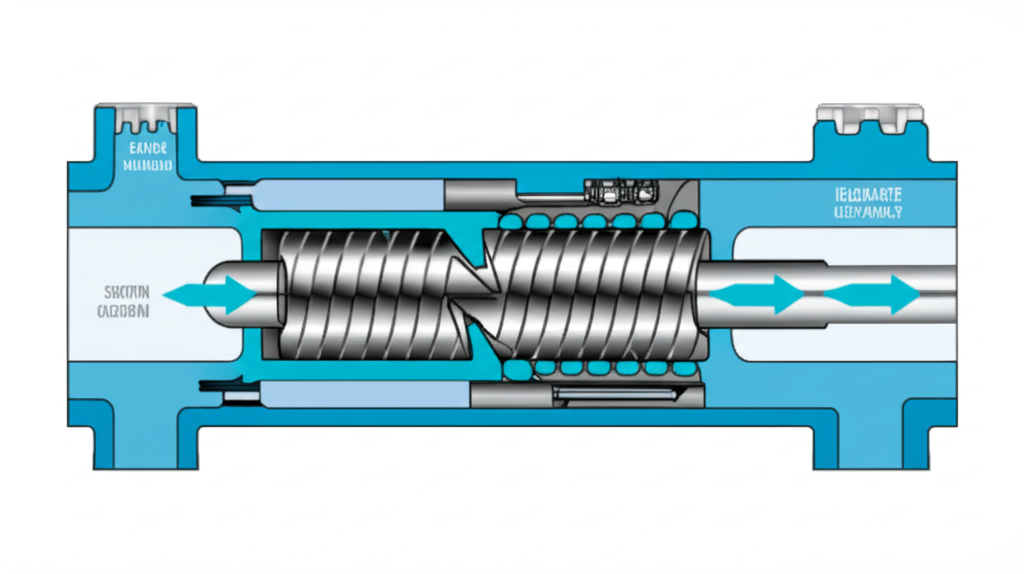
Cross-section showing male and female helical rotors. Air enters through suction (left), is progressively compressed between the lobes, and exits through discharge (right).
Internal Compression Ratio
Each screw unit has a fixed internal compression ratio, determined by rotor and port geometry:
Pressure Matching
If system pressure doesn't match the internal CR, losses occur:
- Over-compression: Internal CR > system pressure (energy waste)
- Under-compression: Internal CR < system pressure (backflow and noise)
Screw Compressor Advantages
| Feature | Benefit |
|---|---|
| Continuous flow | No pulsations, no large tank required |
| High duty cycle | 100% continuous operation |
| Low noise | 65-75 dB typical |
| Long lifespan | 40,000-100,000+ hours |
| Simple maintenance | Predictable intervals |
| Compact | High power in small footprint |
Disadvantages
| Feature | Consideration |
|---|---|
| Initial cost | Higher than piston for small capacities |
| Part-load efficiency | Lower without VSD |
| Contaminant sensitivity | Requires inlet filtration |
| Oil system complexity | In lubricated models |
Screw Compressor Classification
Screw Compressors
├── By lubrication
│   ├── Oil-injected (lubricated)
│   └── Oil-free
│
├── By number of stages
│   ├── Single stage (up to ~190 psi / 13 bar)
│   └── Two stage (up to ~360 psi / 25 bar)
│
└── By capacity control
    ├── Load/Unload (on/off)
    ├── Modulation (inlet valve)
    ├── Variable Speed (VSD)
    └── Hybrid
Typical Applications
| Application | Recommended type |
|---|---|
| General industrial | Lubricated, fixed speed |
| Variable demand | Lubricated with VSD |
| Food and pharmaceutical | Oil-free |
| High pressure (>190 psi) | Two stage |
| Continuous 24/7 operation | Lubricated or oil-free per quality needs |