Control Strategies
Capacity control strategies determine how a compressor adjusts its air production to match demand. The choice of strategy has direct impact on energy consumption.
Main Strategies
1. Inlet Modulation
The compressor reduces inlet flow by throttling suction:
                    Modulation
                      valve
                        │
                        ▼
    Ambient ═══════> [◐ ════] ═══════> Compressor
    air                │
                       └── Variable position
                           0-100%
Efficiency curve: See strategy comparison below.
| Load | Power | Efficiency |
|---|---|---|
| 100% | 100% | Optimal |
| 80% | 90% | Good |
| 60% | 82% | Acceptable |
| 40% | 75% | Poor |
| 20% | 70% | Very poor |
Modulation is the least efficient method for capacity control. At 50% load, a modulating compressor consumes ~78% of rated power. This is significant waste.
2. Load/Unload
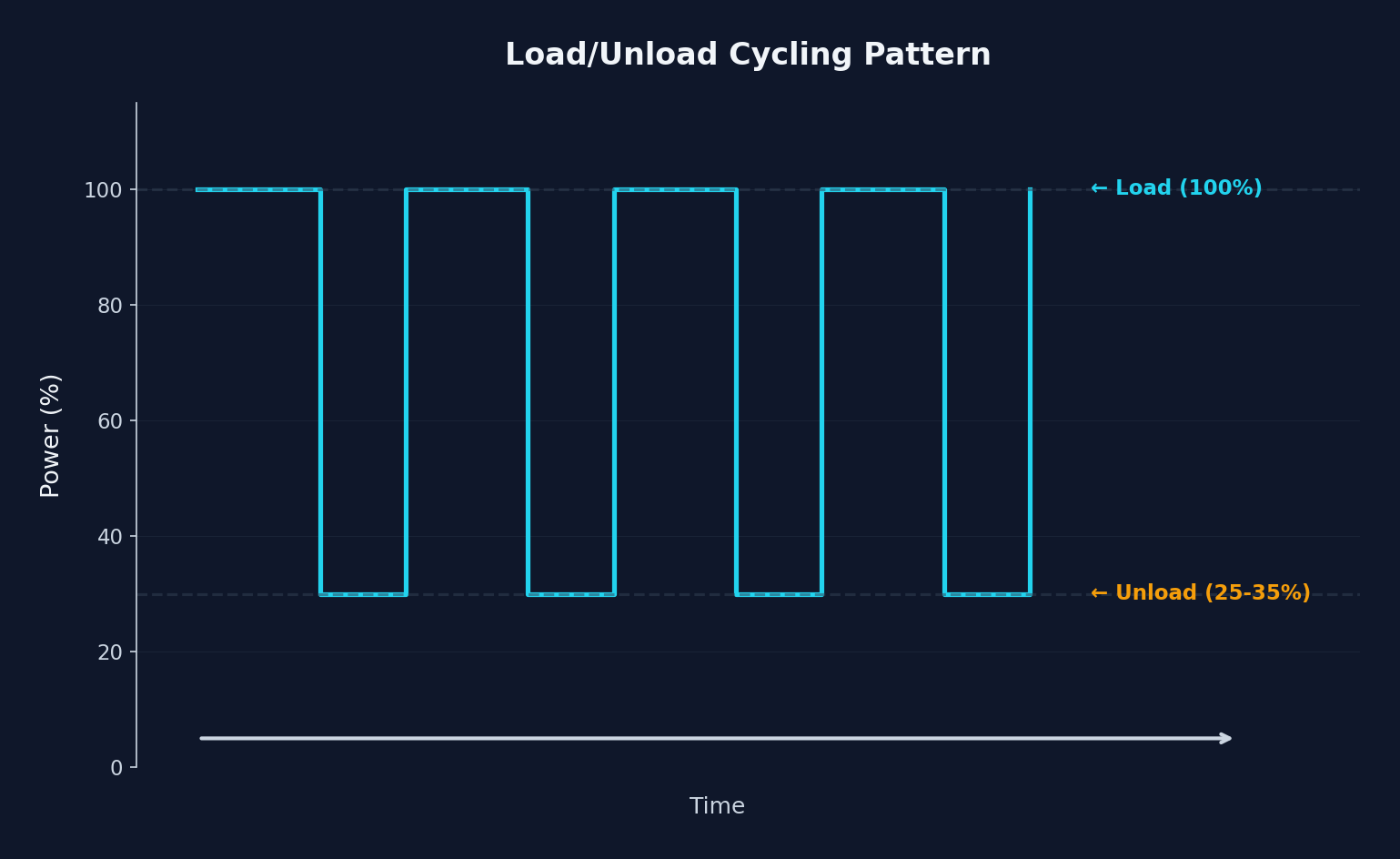
The compressor alternates between full load and unload (idle):
Load Operation:          Unload Operation:

Inlet valve: OPEN        Inlet valve: CLOSED
Production: 100%         Production: 0%
Power: 100%              Power: 25-35%
                                  ↑
                          (parasitic losses)
Typical cycle:
| Parameter | Typical Value |
|---|---|
| Power at load | 100% |
| Power at unload | 25-35% |
| Minimum load time | 30-60 sec |
| Minimum unload time | 10-30 sec |
Efficiency by load:
| System Load | Load Time | Unload Time | Average Power |
|---|---|---|---|
| 100% | 100% | 0% | 100% |
| 75% | 75% | 25% | 83% |
| 50% | 50% | 50% | 65% |
| 25% | 25% | 75% | 48% |
3. Variable Speed (VSD)
The compressor adjusts motor speed according to demand:
                    VFD (Drive)
                         │
                         ▼
    Grid ══════> [~~~~] ══════> Motor ══════> Compressor
    60 Hz        │              │
                 └── 30-60 Hz   └── Variable RPM
Efficiency curve: See strategy comparison below.
| Load | Power | Efficiency |
|---|---|---|
| 100% | 100% | Optimal |
| 80% | 78% | Excellent |
| 60% | 58% | Excellent |
| 40% | 40% | Good |
| 20% | 25% | Acceptable |
4. Variable Displacement
Some screw compressors adjust physical displacement:
                    Bypass
                     valve
    ┌──────────────────┼──────────────────┐
    │                  ↓                  │
    │    Rotors ═══>[===]═══>            │
    │                  │                  │
    │        Internal recirculation       │
    └─────────────────────────────────────┘
| Load | Power | Application |
|---|---|---|
| 100% | 100% | Valve closed |
| 75% | 80% | Partial bypass |
| 50% | 62% | More bypass |
| 25% | 45% | Maximum bypass |
Strategy Comparison
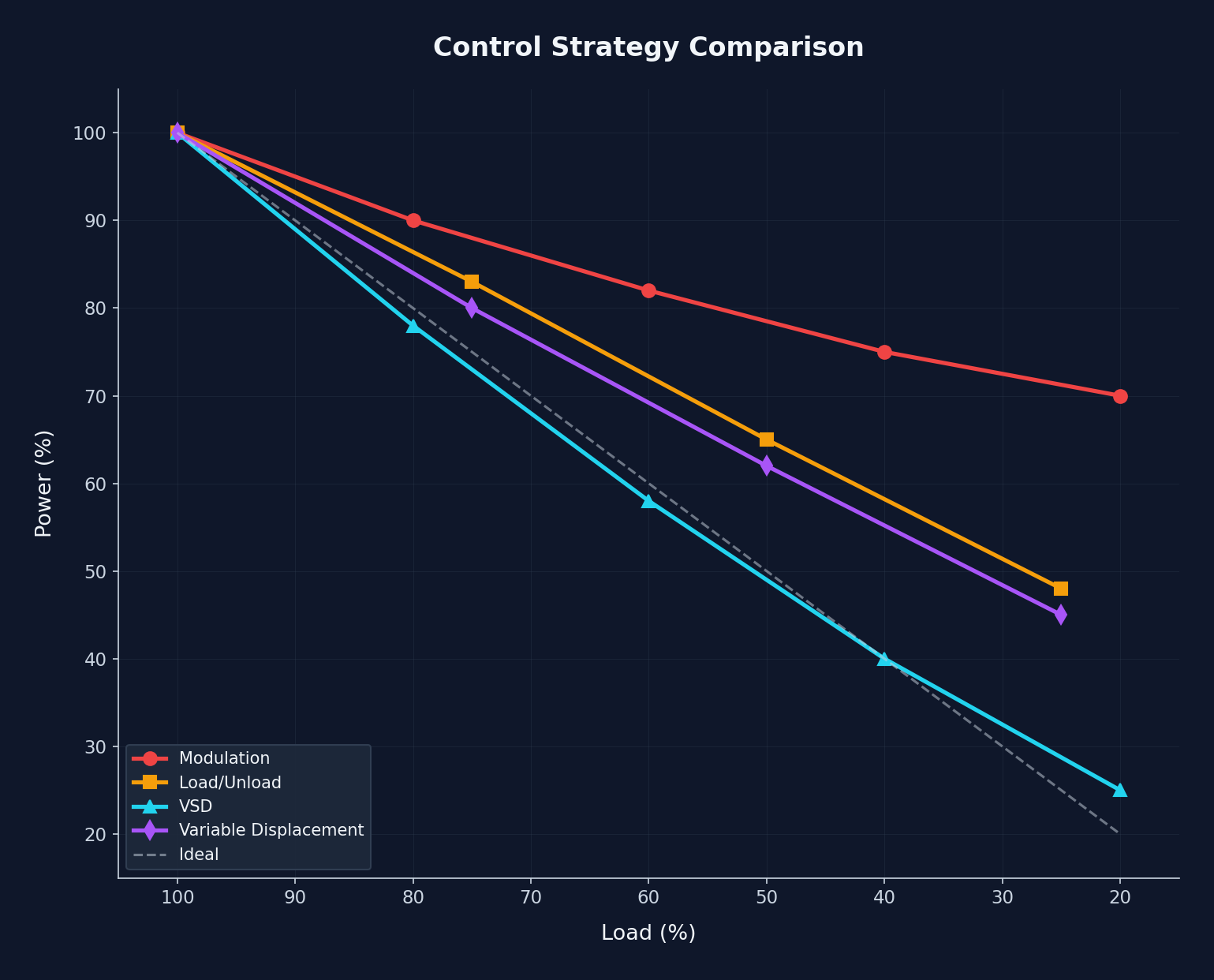
Comparison Table
| Strategy | Efficiency 50% | Cost | Complexity | Best For |
|---|---|---|---|---|
| Modulation | Poor (78%) | Low | Low | Never recommended |
| Load/Unload | Good (65%) | Low | Low | Stable load |
| VSD | Excellent (50%) | High | Medium | Variable load |
| Var. Displacement | Very good (62%) | Medium | Medium | Intermediate |
Strategy Combination
In multi-compressor systems, strategies are combined:
┌─────────────────────────────────────────────────────────┐
│                    TOTAL DEMAND                          │
│                                                          │
│  ████████████████████████████████████░░░░░░░░░░░░░░░░  │
│  │              │              │              │         │
│  ▼              ▼              ▼              ▼         │
│ Comp 1        Comp 2        Comp 3        Comp 4       │
│ FS L/U        FS L/U          VSD          Standby     │
│ 100%          100%           60%            0%         │
│ (Base)        (Base)        (Trim)       (Standby)    │
└─────────────────────────────────────────────────────────┘

FS = Fixed Speed
L/U = Load/Unload
VSD = Variable Speed Drive
Combination Rules
- Base compressors: Fixed speed, operate at 100%
- Trim compressor: VSD, adjusts the difference
- Only one VSD as trim: Avoid "fighting" between VSDs
- Standby on reserve: For emergencies and maintenance
Energy Savings by Strategy
Example: 500 HP System with 60% Average Load
| Configuration | Annual Power | Annual Cost* | Savings |
|---|---|---|---|
| 5x100HP Modulation | 2,520,000 kWh | $252,000 | Base |
| 5x100HP L/U | 2,100,000 kWh | $210,000 | 17% |
| 4x100HP FS + 1x100HP VSD | 1,820,000 kWh | $182,000 | 28% |
| 2x150HP VSD + 1x200HP FS | 1,680,000 kWh | $168,000 | 33% |
*Assuming $0.10/kWh, 8,000 hours/year
For new installations, always consider at least one VSD as "trim". The additional cost is typically recovered in 1-3 years.