Dryers in Detail
Moisture is the enemy of pneumatic systems. Proper drying prevents corrosion, contamination, and equipment failure.
Why Dry Compressed Air?
The Moisture Problem
 Moisture removes lubrication and causes oxidation, increasing friction and wear.
- Ambient air at 70% humidity becomes 100% saturated when compressed
- As it cools in piping and equipment, water condenses
- Water causes:
- Corrosion of piping and equipment
- Washing away of lubricants
- Increased friction and wear
- Product contamination
- Freezing in cold environments
Moisture Measurement
| Measure | Description |
|---|---|
| Relative Humidity (%) | Percentage of maximum moisture air can hold |
| Dew Point (°F/°C) | Temperature at which condensation begins |
Moisture Content Comparison
| Condition | Water Content |
|---|---|
| Air @ 50°F dew point | 11.5 g/m³ |
| Air @ -40°F dew point | 0.0117 g/m³ |
Air dried to -40°F dew point contains 1000x less moisture!
Dryer Types
1. Refrigerated Dryers
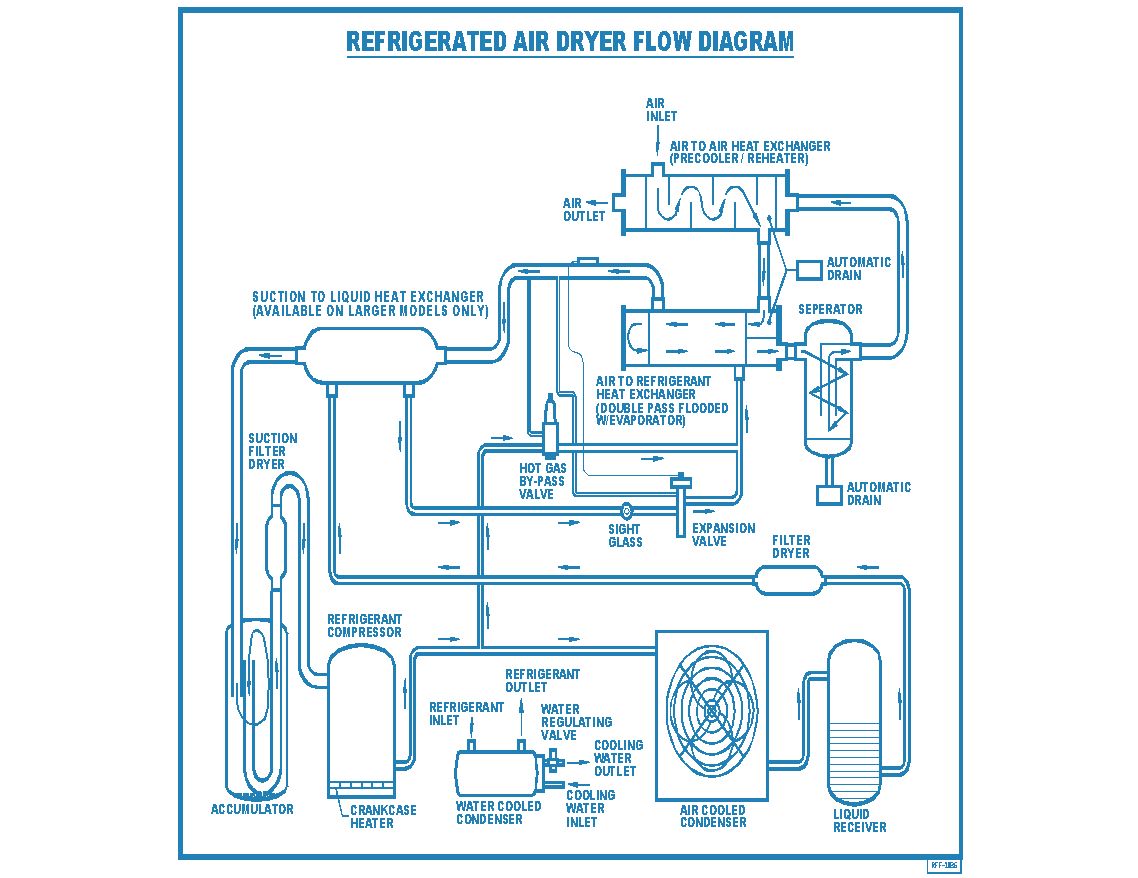 Refrigerated dryer components: heat exchangers, refrigerant compressor, separator, and automatic drains.
How They Work:
- Hot, humid compressed air enters
- Air-to-air exchanger pre-cools incoming air
- Air-to-refrigerant exchanger cools air to ~38-50°F
- Moisture condenses and separates
- Cold, dry air reheats outgoing air (recovering energy)
Specifications:
| Parameter | Value |
|---|---|
| Dew Point | 35-50°F (2-10°C) |
| Typical pressure drop | 3-5 PSI |
| Energy consumption | Low-moderate |
Refrigerated Types:
- Non-cycling: Refrigerant runs continuously - consistent dew point
- Cycling: Refrigerant cycles based on load - energy savings at partial loads
2. Desiccant Dryers (Adsorption)
Use desiccant material to adsorb moisture from the air.
How Adsorption Works:
Moisture molecules are attracted to the desiccant surface due to the vapor pressure difference between humid air (high vapor pressure) and dry desiccant (low vapor pressure).
Regeneration: The desiccant must be periodically regenerated by expelling collected moisture.
Desiccant Types:
- Activated Alumina (most common)
- Silica Gel
- Molecular Sieves
Heatless Regeneration (Pressure Swing)
| Parameter | Value |
|---|---|
| Dew Point | -40°F to -100°F |
| Purge air | ~15% of rated flow |
| Cycle time | 5-10 minutes |
| No external heat required |
Uses a portion of dry compressed air to regenerate the offline tower.
Heated Regeneration
| Parameter | Value |
|---|---|
| Dew Point | -40°F to -100°F |
| Purge air | ~7% of rated flow |
| External heaters | Yes |
| More efficient in larger sizes |
Blower Purge
| Parameter | Value |
|---|---|
| Dew Point | -10°F to -40°F |
| Purge air | 0% (uses ambient air) |
| External blower + heater | Yes |
| Most energy efficient for continuous use |
Dew Point Selection Guide
| Application | Required Dew Point |
|---|---|
| General plant air | 35-50°F |
| Outdoor piping (no freezing) | 35°F |
| Outdoor piping (cold climates) | -40°F |
| Spray painting | 35-50°F |
| Food processing | -40°F |
| Pharmaceutical | -40°F to -100°F |
| Electronics manufacturing | -40°F |
| Instrument air | -40°F |
Common Mistakes
"I'll Just Drain More Often"
Draining removes bulk water but does NOT reduce humidity. The air remains saturated and will continue condensing downstream.
Solution: Proper drying equipment, not just drainage.
Ignoring Pressure Dew Point vs Atmospheric
A dryer with -40°F pressure dew point @ 100 PSIG will have a much lower atmospheric dew point when expanded. Always specify pressure dew point for compressed air systems.
Energy Consumption by Type
| Dryer Type | Relative Energy Use |
|---|---|
| Refrigerated (non-cycling) | Low |
| Refrigerated (cycling) | Very Low |
| Desiccant heatless | Moderate (purge loss) |
| Desiccant heated | Moderate-High |
| Blower purge | Low (for desiccant type) |
Match dryer type to actual dew point requirements. Don't over-dry - a -40°F dew point costs significantly more than 35°F if you don't need it.
Dryer Sizing Calculations
Basic Sizing Parameters
| Parameter | Symbol | Units |
|---|---|---|
| Flow rate | Q | CFM or m³/min |
| Inlet pressure | P₁ | PSIG or bar |
| Inlet temperature | T₁ | °F or °C |
| Required dew point | PDP | °F or °C |
| Ambient temperature | Tₐ | °F or °C |
Correction Factors
Dryer ratings are typically at standard conditions:
- 100 PSIG (7 bar)
- 100°F (38°C) inlet temperature
- 100°F (38°C) ambient temperature
Actual capacity must be corrected:
Where:
- C_P = Pressure correction factor
- C_T = Inlet temperature correction
- C_A = Ambient temperature correction
Pressure Correction (Refrigerated Dryers)
| Pressure (PSIG) | C_P Factor |
|---|---|
| 50 | 0.75 |
| 75 | 0.88 |
| 100 | 1.00 |
| 125 | 1.10 |
| 150 | 1.18 |
| 175 | 1.25 |
Temperature Correction (Refrigerated Dryers)
| Inlet Temp (°F) | C_T Factor |
|---|---|
| 80 | 1.28 |
| 90 | 1.13 |
| 100 | 1.00 |
| 110 | 0.88 |
| 120 | 0.77 |
Sizing Example
Application:
- Required flow: 500 CFM
- Operating pressure: 125 PSIG
- Inlet temperature: 110°F
- Ambient temperature: 95°F
Correction factors:
- C_P @ 125 PSIG = 1.10
- C_T @ 110°F = 0.88
- C_A @ 95°F = 1.04
Required rated capacity:
Select dryer rated for ≥500 CFM at standard conditions.
Add 10-25% safety factor for flow variations and future expansion.
Purge Air Losses (Desiccant Dryers)
Understanding Purge Loss
Desiccant dryers require purge air to regenerate the saturated tower. This air is lost to atmosphere.
Twin-tower operation:

    Tower A (Drying)              Tower B (Regenerating)
    ┌─────────────┐               ┌─────────────┐
    │ ░░░░░░░░░░░ │               │ ░░░░░░░░░░░ │
    │ ░ Dry ░░░░░ │               │ ░ Wet ░░░░░ │
    │ ░ Desiccant │               │ ░ Desiccant │
    │ ░░░░░░░░░░░ │               │ ░░░░░░░░░░░ │
    └──────┬──────┘               └──────┬──────┘
           │                             │
    Wet ───┴──→ Dry              Purge ──┴──→ Atmosphere
    air in     air out           air in      (LOST)
Purge Rates by Dryer Type
| Dryer Type | Purge Rate | Comments |
|---|---|---|
| Heatless | 15-18% | At rated flow, higher at part load |
| Heated (internal) | 7-10% | Plus heater energy |
| Heated (external) | 2-5% | Blower + heater |
| Blower purge | 0% | Uses ambient air |
| HOC (heat of compression) | 0% | Uses compressor heat |
Calculating Purge Cost
Example: 500 CFM heatless desiccant dryer
Purge loss = 15% of rated capacity
Annual purge cost:
Assuming:
- 0.25 kW per CFM (typical compressor efficiency)
- 8,760 hours/year
- $0.10/kWh
Heatless dryers purge at fixed rate regardless of actual flow. At 50% load, effective purge loss doubles to 30% of actual flow!
Purge Reduction Strategies
| Strategy | Savings | Notes |
|---|---|---|
| Dew point demand control | 30-50% | Adjusts cycle based on actual load |
| Heated regeneration | 50% | Trade electricity for air |
| Blower purge | 100% | No compressed air used |
| Heat of compression (HOC) | 100% | Uses waste heat |
Dew Point Demand Control
Without demand control:     With demand control:
(Fixed cycle timing)        (Variable cycle timing)

Dew Point                   Dew Point
    │    ╱╲   ╱╲   ╱╲          │    ╱╲        ╱╲
-40°├───╱──╲─╱──╲─╱──╲───      ├───╱──╲──────╱──╲──
    │  ╱    ╲    ╲    ╲        │  ╱    ╲    ╱    ╲
    │ ╱      ╲    ╲    ╲       │ ╱      ╲──╱      ╲
    └────────────────────      └────────────────────
       Time                       Time

Cycles when not needed      Cycles only when needed
Total Cost of Ownership
Comparing Dryer Types (500 CFM example)
| Factor | Refrigerated | Heatless Desiccant | Heated Desiccant |
|---|---|---|---|
| Capital cost | $8,000 | $12,000 | $18,000 |
| Dew point achieved | 38°F | -40°F | -40°F |
| Annual energy (kWh) | 8,760 | 0 | 15,000 |
| Annual purge loss | 0 | $16,425 | $8,212 |
| Annual energy cost | $876 | $0 | $1,500 |
| Annual maintenance | $500 | $1,500 | $2,000 |
| Total annual cost | $1,376 | $17,925 | $11,712 |
10-year total:
- Need 35-50°F PDP → Refrigerated (lowest cost)
- Need -40°F, intermittent use → Heated desiccant
- Need -40°F, continuous 24/7 → Blower purge or HOC
Dryer Installation Best Practices
Location Requirements
Proper installation layout:

                          ┌──────────────┐
    Aftercooler          │              │    Dry air
    ────────────→ Filter → │    DRYER    │ ──────────→
                   Pre    │              │    out
                          └──────────────┘
                                 │
                            Condensate
                             drain
                                 │
                                 ▼
                          Condensate
                          management
| Requirement | Reason |
|---|---|
| Level installation | Proper condensate drainage |
| Adequate ventilation | Heat dissipation (refrigerated) |
| Accessible filters | Maintenance access |
| Bypass piping | For maintenance without shutdown |
| Condensate management | Environmental compliance |
Common Installation Mistakes
- No pre-filter - Contaminates dryer internals
- Too close to wall - Blocks airflow (refrigerated)
- Hot inlet air - Reduces capacity
- No bypass - Forces shutdown for maintenance
- Oversizing - Short cycling in refrigerated dryers