Two-Stage Compressors
Two-stage compressors use two cylinders in series to achieve higher pressures with greater efficiency.
Operating Principle
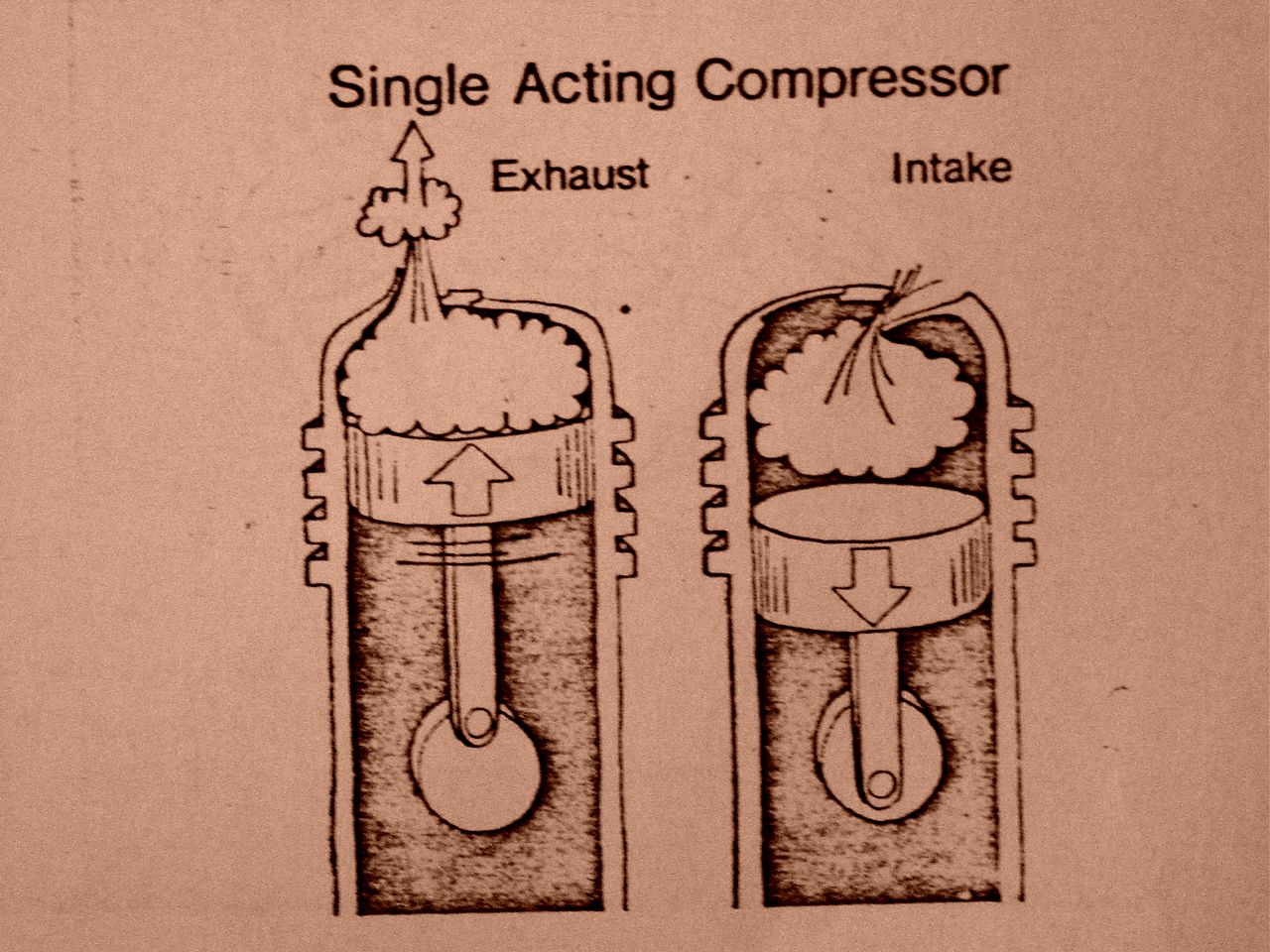 Intake and discharge in compression stages.
                    Intercooler
                         │
    ┌─────────┐    ┌─────┴─────┐    ┌─────────┐
    │         │    │  ≋≋≋≋≋≋≋  │    │░░░░░░░░░│
    │         │───→│  ≋≋≋≋≋≋≋  │───→│░░░░░░░░░│───→ Discharge
    │  1st    │    │  ≋≋≋≋≋≋≋  │    │  2nd    │     175 PSI
    │  Stage  │    └───────────┘    │  Stage  │
    │         │                     │(smaller)│
    └────┬────┘                     └────┬────┘
         │                               │
    Intake                          Smaller
    (atmospheric)                   cylinder
Process
- First stage compresses to intermediate pressure (~50 PSI)
- Air passes through the intercooler (cools down)
- Second stage compresses to final pressure (up to 175+ PSI)
- Air passes through the aftercooler before the tank
Why Two Stages?
Single Stage Problem
Compressing from 0 to 175 PSI in a single stage causes:
| Problem | Consequence |
|---|---|
| Very high temperature | >300°F (150°C) at discharge |
| Low efficiency | Much energy lost as heat |
| Accelerated wear | Oil degrades, seals fail |
| Ignition risk | Oil can ignite |
Solution: Staged Compression
| Parameter | Single Stage | Two Stage |
|---|---|---|
| Discharge temp. | over 300°F | under 200°F |
| Efficiency | 60-70% | 80-85% |
| Oil life | Short | Normal |
| Duty cycle | 50% | 75-100% |
The Intercooler
The intercooler is a heat exchanger between stages:
    Hot air              Cool air
    from 1st stage       to 2nd stage
         │                     │
         ↓                     ↓
    ┌────────────────────────────┐
    │  ═══════════════════════   │
    │  ═══════════════════════   │ ← Tubes with air
    │  ═══════════════════════   │
    └────────────────────────────┘
              ↑       ↑
         Cooling air
         (fan)
Intercooler Types
| Type | Medium | Application |
|---|---|---|
| Air-to-Air | Ambient air | Most common, simple |
| Water-to-Air | Water | Higher capacity, industrial |
Benefits of Intercooling
- Reduces compression work - Cool air is denser
- Lowers final temperature - Protects components
- Separates condensate - Water condenses between stages
- Higher efficiency - Up to 15% energy savings
Cylinder Sizing
In a two-stage compressor, cylinders have different sizes:
    1st Stage              2nd Stage
    (large)                (small)

    ┌─────────────┐       ┌───────┐
    │             │       │       │
    │             │       │       │
    │      ●      │       │   ●   │
    │             │       │       │
    │             │       │       │
    └─────────────┘       └───────┘

    Larger volume          Smaller volume
    Lower pressure         Higher pressure
Size Relationship
The ideal cylinder ratio is calculated so each stage does approximately equal work:
V₁/V₂ ≈ √(P₂/P₁)
For a typical 175 PSI compressor:
- First stage: ~4 times the volume of the second
- Each stage has ~4:1 compression ratio
Common Configurations
Inline (Tandem)
    ┌─────┐     ┌───┐
    │ 1st │─────│2nd│
    │     │     │   │
    └──┬──┘     └─┬─┘
       │          │
       └────┬─────┘
            │
       Crankshaft
- Compact design
- Common in small compressors
V-Configuration
         ┌───┐
        ╱ 2nd╲
       ╱     ╲
    ┌─────┐
    │ 1st │
    └──┬──┘
       │
    Crankshaft
- Better balance
- Less vibration
W or Radial
For high-capacity compressors with multiple cylinders.
Typical Specifications
| Parameter | Typical Range |
|---|---|
| Maximum pressure | 145-175 PSI (10-12 bar) |
| Power | 3-30 HP |
| Flow | 10-100 CFM |
| Duty cycle | 75-100% |
| RPM | 600-1,200 |
Two-Stage Compressor Advantages
| Advantage | Description |
|---|---|
| Higher efficiency | 15-20% more efficient than single stage |
| Lower temperature | Components last longer |
| Higher pressure | Easily reaches 175+ PSI |
| Better duty cycle | Can operate continuously |
| Drier air | Condensate separates between stages |
When to Choose Two Stage
| Application | Single Stage | Two Stage |
|---|---|---|
| Occasional use | ✓ | |
| Pressure < 100 PSI | ✓ | |
| Pressure > 100 PSI | ✓ | |
| Continuous use | ✓ | |
| Multiple tools | ✓ | |
| Professional shop | ✓ |
Smart Investment
Although two-stage compressors cost more initially, energy and maintenance savings make them more economical long-term for intensive use.